Wednesday, February 19, 2014

Quick at home work out

Warm up:


  • Jump rope or Jumping Jax for about 5 minutes
  • 20 Reps Burpees
  • 100 Reps Mountain Climbers 


Circuit:


  • Push up/ Burpee to failure 15 reps
  • Chair Dips/ Jumping Jax 2 minutes 
  • DB Curl (20 lbs each arm) to lunge/ mountain climber to failure 50 reps 
  • Bicycle abs / jumping Jax to failure 2 minutes


Thursday, January 9, 2014

DJCETA


I will be kinder to the person after you and I’m sorry for that.
When he goes for my hand I won’t pull away
He will see my smile more often than you did
I will wait up for him on late nights
I will let him hold me when I am feeling fragile
He will hear the 3 words that I could never say to you.
I’m sorry that you loved me when I didn’t love me.
God bless you and your ability to stay warm when I was always so cold.
————————————————————————————–
I’ve recently had a lot of guys writing in asking me why girls are always passing up on the “nice guy”. This is something that I’m absolutely guilty of. Obviously every situation is unique and I can’t speak for all girls, so I will just speak for myself when I say that in most of those cases I just wasn’t mentally ready for a “good” guy.
I had a less than ideal family experience growing up, and because of it, I grew into a wounded animal that snapped at anyone who was trying to help. I was always hurting and most of the time I didn’t even know why. In my mind I just needed to be with someone who cared about me, hoping that it would make all of the sadness and anger disappear. That was my biggest mistake. I ended up on an endless cycle of letting the wrong people in and getting hurt. Adding heartbreak to my already aching heart just put my brain in complete disarray. I couldn’t even recognize a good guy or healthy relationship if it was staring me directly in the face.
It took me years to understand that I am not unlovable.
I know now that unless I have a healthy, loving relationship with myself, I’m never going to have that with someone else.
Love yourself first.
Xo
Marysinn

Sunday, January 5, 2014

2013

Prologues are unfathomable to me. How do you introduce a life, an experience, a moment in time with a straight face? They are cumbersome to me because they imply their counterpart: epilogue: the end. There is no end while we still have a pulse to anything that transpires and even that is debatable.. Writing itself, is bizarre. How do you write 300 pages of a life trying to encapsulate the hum drum tediousness of an existence where you barely feel like getting out of bed for? How does one discern the important parts that relieve some magical healing road in which enlightenment begins? I’d rather just say this: I was born, I lived, I’ll die, and I did it in less than 700 characters.

Monday, July 8, 2013

Religion and Dogma

Look up the definition of religion in the dictionary and you’ll discover several definitions under the one word. Here is one in particular: “something one believes in and follows; a point or matter of ethics or conscience.” When the concept of religion comes to mind I’m sure most people think in terms of an organized, specific, and fundamental set of beliefs and practices generally agreed upon by a group of people or sects. But it occurred to me that with the above definition in mind everyone has a religion. Ask an atheist what his/her religion is and he/she will tell you, “I’m an atheist.” All religion really is, is a system of beliefs. But whether a person defines their beliefs by a known system such as Christianity, Paganism, Buddhism or Islam, or uses more abstract and vague terms to describe their own unique set of beliefs, or whether one flatly denies the existence of a higher power (this, I may never understand, although I am humbled by humanity’s endless diversity), how one views the nature of reality is really one’s religion.

There is certainly a substantial amount of unfavorable attention that has been had concerning the subject: Jihads and holy wars, hypocrisy, superstition, fear, fanaticism, ignorance, blind acceptance, self-righteousness, rigidity, inquisitions, dogmatism, cruelty, prejudice, persecution, animal sacrifice, human sacrifice, book-burning, witch hunts, conformity, morbid guilt, insanity, even genocide just to list some that fall under the broad spectrum of atrocities committed and conditions endured for the sake of religion.

How is it, I wonder, that an atheist might have a more highly developed sense of Christian morality, for example, than say, a Catholic who routinely attends mass or a Protestant who is faithfully attends church? The problem is not religion, the problem is people. People tend to be dogmatic. An atheist can be just as dogmatic about unbelief as a believer can about belief. Therefore, it is not religion or beliefs that we need to shake off, it is dogmatism.

Sunday, July 7, 2013

If...


If you were the person you most wanted to be, who would you be? If you could be doing anything right now, what would you you be doing? If you could change anything in the world, what would it be?

If you were completely free to express your most dearly held dreams and visions, how would you do that? If you were wealthy enough to buy anything at all, how would you use and invest that wealth in a meaningful way?

If you had the time, the money, the knowledge, the energy and the resources to pursue your highest vision, what would you seek to do? If you were free from all the things that limit you and hold you back, in what direction would you go?

Stop for a moment and consider these things. Then consider this:
There is no need to wait a single moment longer. You can start now to follow your most compelling passion, to achieve your most treasured dreams.

Yes, there are obstacles that stand in your way, but when you're living with purpose and passion, you will find a way around any obstacle and beyond any difficulty.


XOXO
Marysinn


Friday, June 7, 2013

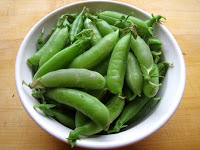
Snap Pea, Radish, Mint and Ricotta Salata Salad


Snap pea season is coming to an end. Here's a refreshing recipe.

You can substitute the ricotta with feta or even with blue cheese. A delicious and perfect side to a nice juicy stake and an ice cold lime margarita. 


4 servings

Prep time: 20 minutes

Cook Time: 10 minutes

Total Time: 30 minutes


INGREDIENTS

2 tablespoons hazelnuts

Ice

1 teaspoon kosher salt

1 pound snap peas, vine end trimmed

2 tablespoons fresh lemon juice

1 tablespoon extra-virgin olive oil

½ teaspoon flaky sea salt

6 medium radishes, trimmed and sliced into thin wedges

2 tablespoons crumbled ricotta salata

6 large basil leaves, roughly torn


DIRECTIONS

1. Preheat the oven to 350°. On a rimmed baking sheet, add the hazelnuts and roast until toasted, about 8 minutes. Enclose the hazelnuts in a kitchen towel, then use the towel to rub the papery skins from the hazelnuts. Unwrap and set the hazelnuts aside to cool completely before roughly chopping.

2. To a medium bowl, add ice and water and set aside. Bring a large saucepan of water to a boil. Add the kosher salt and the snap peas and simmer until the peas are crisp-tender, about 1 minute. Drain the snap peas in a colander and immediately transfer them to the ice-water bath to stop the cooking. Once the snap peas are chilled, drain, then transfer the vegetables to a kitchen-towel-lined baking sheet pan to drain further.

3. In a large bowl, whisk together the lemon juice, olive oil and sea salt. Add the drained snap peas and the radishes and toss to combine. Sprinkle the ricotta salata, torn basil and chopped hazelnuts over the top and serve.


Enjoy

XOXO
Marysinn


Saturday, April 13, 2013

Poor Eating Habits: A Century in the Making


What is making Americans gain weight? Which foods are responsible for the obesity epidemic? Is it soda? Fast food?


In the May 2010 issue of the American Journal of Clinical Nutrition, I published a detailed analysis of how diets have changed over the past century, based on government records going back to 1909. The results were surprising—even sobering—and I thought I would share them with you. Here’s what we found:


Compared to a century ago, an average American now eats 75 pounds more meat every year. Although red meat made a big charge early in the last century, the recent increase has all been related to chicken. Convinced that chicken is somehow health food, Americans now eat more than one million chickens per hour. Perhaps surprisingly, its fat content is not much different from beef (about 29% for lean beef, 23% for skinless chicken breast, compared to less than 10% for typical vegetables, fruits and beans.)


Cheese intake back in 1909 amounted to less than four pounds per person per year. Americans had not yet discovered cheese pizza or cheeseburgers, or the fact that schoolchildren will happily munch on cheese day after day. Today, cheese intake is over 30 pounds per person per year. Unfortunately, typical cheeses are about 70% fat, as a percentage of calories, and most of that is saturated fat—the kind that raises cholesterol.


And along with our meat and cheese, we’re munching on French fries, which accounts for a 50-pound rise in oil consumption per person per year compared to a century ago. And we’re polishing our fries off with frozen desserts, particularly ice cream. The average American eats 20 pounds more ice cream per year than a century ago.


So, what’s behind these huge increases? Much of this change reflects the advent of fast-food and pizza restaurants, for which meat, cheese and fryer grease are staples. Also, government subsidies make meat, dairy products and sugar cheaper and more available than they would be otherwise, and government meal programs ensure that children consume these less-than-healthful foods in schools on a daily basis.


But what about sodas? They are commonly blamed for childhood obesity. It’s certainly true that soda intake is way up. But, among children, this rise has been partly compensated for by a drop in milk intake. Nonfat milk has about the same calorie intake as soda, and whole milk is denser in calories than soda. So, calorie-wise, it appears to be nearly a wash.


Bottom line: Americans were moderate meat-eaters a century ago, and are vigorous carnivores today. Cheese intake has exploded, and greasy, sugary foods are more prevalent than ever.


If we turn the clock back a bit, we might see the difference on the scale.


By Neal Barnard MD